Oh, summertime has set in for good here in Miami, hot, steamy and a flooding scenario from Tropical Storm Andrea the other day. We had seven inches of rain, and areas all around us had much more, and hundreds of cars were ruined, and dozens of homes were waterlogged. Luckily, my home is on a high and dry piece of land!
I'm so busy with private label, students, the Guild and my day-to-day perfume work, I've been a bit absent from the 'social' whirl of the Internet, so please forgive me. I even skipped Ask the Perfumer last week, so I'm playing catch-up now.
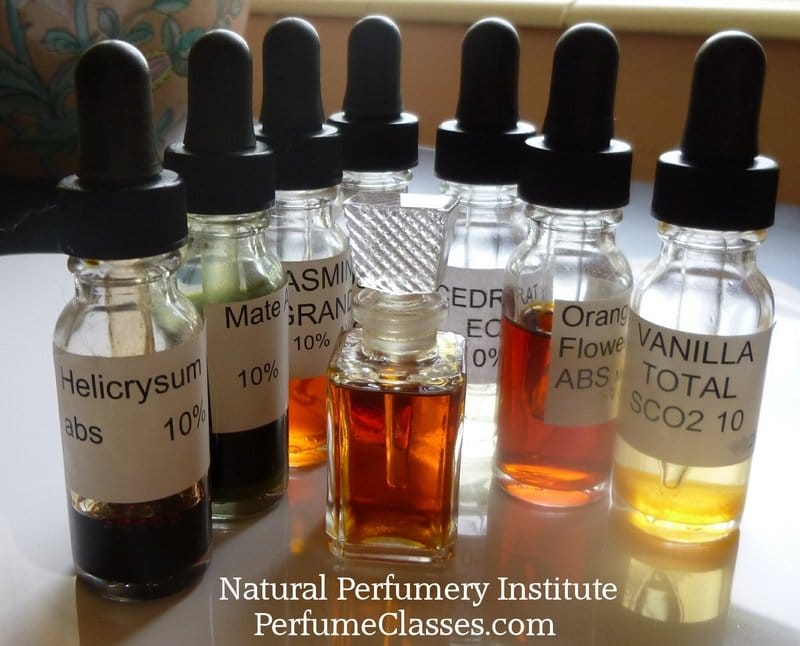
Dilution of costly aromatics and use of dropper bottles is one of the first exercises for Natural Perfumery Institute students https://PerfumeClasses.com
I've been playing around with some photo techniques, settings and such, and hoping to improve my skills. I grabbed a 10ml flacon of Royal Lotus and arranged it with some of the dropper bottles I teach my students to make for their studies. The dropper/dilution technique is something they'll use for their entire career as a professional perfumer. More should teach this technique! It saves money, aromatics, and gives you a clearer idea of what the final perfume will smell like as you make your mods.
Do you have any perfumery questions for me today or tomorrow? I'm so late getting started today, I'll extend ATP until tomorrow. And yes, I'll choose a post for someone to win the 10 mls of Royal Lotus! This is an exquisite, very costly perfume with a rich citrus top accord, different lotuses and night-blooming jasmine in the heart, and a sandalwood drydown. Leave a comment by 11:59PM Monday, June 10 to be in the running.
Bummer: this is open to USA and Canadian residents only. HOWEVER, I will ship a luxe size bar of either my Patchouli Silk or Spice Silk bar to an international visitor. Now.... off to get some better photos of my soaps!
Please let me know if you're in the USA or international, and also if you've subscribed to the blog. If you're already a subscriber and you comment, you're automatically entered twice!

Hi Anya,
Love your products! My question is as follows: In my experience with natural perfumes, some seem to “separate” and leave a sticky, sap-like residue (especially as it nears the bottom of the flacon), while others do not. I’m curious to know which component of the perfume is settling to the bottom, and what the reason for this might be. Thank you!
Hi Maria:
Thank you for loving my products, I create them out of love and passion, as I have been doing, for decades!
About the sticky residue: sometimes resins will do this. When the alcohol starts to evaporate off as the bottle is opened and used, the resins thicken. Natural perfumers may contain resins, and even mainstream ones do. I have a number of vintage perfumes with the ‘syrup’ (as I call it) on the bottom. You may wish to add a few drops of alcohol to re-dilute the syrup, but be aware your perfume maybe a bit cloudy. Nothing wrong with it, just the way syrup may behave.
HTH,
Anya
What advice would you give to someone just starting their journey into perfume? I know that is a big question to ask XD. I also was wondering if I make a single note perfume (say just frankincense because I love the smell), how long would I wait for it to mature in the carrier oil if it is only one ingredient?
Thank you so much, and thank you for holding this wonderful giveaway!!
Hi Ashesela:
If you’re making a single-note perfume, you can use it immediately. It’s when you start combining essences, you need to wait and observe how they interact: some may take over the blend, others may just fade, or they may make a stink!
HTH,
Anya
Thank you so much for your reply!! 😀
Happy Sunday!
What reading materials would you suggest as a prerequisite before taking a perfumery course? I’m looking for some good ones to help me learn this summer.
Hi Rachel:
I would recommend what I started with, a true gem that gave insight into both the workings of a perfumers mind, and details on how to evaluate combining essences: William I Kaufman’s Perfume, pub. 1974. I found it in 1976, and was overwhelmed with excitement, since there was a scarcity of ‘how to’ books on perfumery. I’ve been recommending it since 2002, and I know a lot of perfumes on my Yahoo group benefited from it.
I took the decades of working with the charts and redesigned them for my students. You don’t have to know chemistry to become a perfume via this method: the methodical comparing and contrasting will help you see what the mods will become.
There are beginner books out there, but I shy away from them. In 2005 I finally got a touted book, and was shocked that there was no real professional methodology in it. Drops of labdanum? Undiluted? What a nightmare to work with!
Good luck and best wishes,
Anya
I’ve read that chemists say they are making a “bio-identical” scent molecule to the real thing (in some cases). Is this really possible? Thanks. And thank you for having a giveaway!
Hi Julie:
Yes, bio-identical dupes are available, but I wouldn’t want them because I’m a natural perfumer. Why would I want a synthetically-made rose when I can use the real rose?
HTH,
Anya
Hi Anya!
I admire your work and your love to natural substances!
My question would be – how long can you keep natural perfume, if it is kept in a dark dry, not so hot place? Does the shelf life depends on the ingredients used, or there is a generic time for any natural perfume? I’m asking this, because I have mixed (as I believe, perfume is an art of mixing aromatics 🙂 my own perfume, 10ml, it was maybe 4 years ago. The base was jojoba oil. As the first creation, it smelled a little bit too sharp, but since then, that sharpness faded and now it smells much better 😀
Thank you!
Hi Rita:
This is a good day, I’m getting lots of compliments, they do make the workload a bit easier to bear!
I’m skipping to the end of your question first: when you observed with the jojoba oil perfume is simple aging, which is necessary for perfumes to mature.
If you’re a perfumer, you age them before release. It doesn’t take years. Then, a properly-made perfume will last for many years. I have archived bottles of my perfumes from 2006, kept in a cool (78F), dark place, and they’re fine.
As far as ingredients used, let’s use citruses as an example: they will fade in a year or two, so the topnotes may be lost, but they won’t cause the perfume to ‘go bad’.
HTH,
Anya
Hi Anya, Loving all these questions and answers. I haven’t had any time to work in my perfume lab because garden design season is high but I am tincturing lots of petals from my own organic garden. Just tested the philadelphus tincture on my arm and it’s so beautiful! Also doing lots of fragrant roses, jasmine, lemon blossom and scented daylily.
I’ve also started to tincture alcohol for cocktails. I made a quart of tiny elderberry flowers in 190 proof and some simple syrup and am letting it sit for at least a month or 2 to let it mellow. I tried vodka and deep violet rose petals as well but the scent is very faint with vodka however the color is great!
Hope you and yours stay safe and sound during storm season!
Hi Suzinn:
Non-perfumers might not understand how time- and emotion-demanding perfumery is, eh? You have to be able to concentrate.
Tincture/enfleurage season is in full swing here, too, with jasmines, frangipanis, aglaias, Chinese honeysuckles leading the list.
is the scent of the elderberries coming over? I’ve made elderberry tincture with low-proof alcohol for years for medicinal purposes.
Don’t mention storms! Shhhh!
xoxo,
Anya
How long do you leave your own blends to mature before you consider them ready to market and do you always filter them?
Hi Mumsy:
ALWAYS filter via the chill method. Sparklingly-clear perfume is the goal. That said, sometimes those little bottles, esp with CO2s in them, get a little hazy, depending on the temperature. You can put up with that, but little floatie bit? No.
Maturation time varies, light perfumes usually two months (think citruses, light florals), heavier ones up to six months. There are shortcuts taught in the advanced course, to be used after the perfumer has a lot of experience.
Best wishes,
Anya
Hi Anya,
While I’ve enjoyed the questions and answers of the others today, I have none of my own for the moment. I am delighting in the samples of your fragrances that I recently purchased. I just tried a dab of Royal Lotus before sitting down here at my desk. Serendipity to see that you have a giveaway of it. Haven’t gotten to the sandalwood dry-down yet. It is quite wonderful indeed and maybe my favorite so far. Thanks for the giveaway!
Dear Susan:
Royal Lotus is intoxicating, all that richness!
Take care and best wishes as your studies advance,
Anya
Hello from Paradise Island PR…I visit our friend Jose Perez at his lovely town Lares PR. I can’t wait to market frangances. While we were talking about perfume he sold out his Lotus fragrance soap & colones. For some reason customers love the smell of Lotus.
Dear Eileen:
Enjoy yourself in PR! I’ll bet Juan’s products are beautiful. Don’t you like Lotus?
xoxo,
Anya
Hello, I have worked tincture of goat hair, and I’m interested in How to use perfume. Thank you!
Dear Nada:
Recognize it is an assertive fixative note. First, you must filter it well. Then add a tiny bit and let it age and see how it performs in the mod. Since it’s such a new aromatic to you, you must get to intimately know it and recognize its potential to soften and make a perfume musky, but not allow it to be overpowering.
HTH,
Anya
Anya,
The new photo looks great! I love the way the light hits the bottles =)
Even though I long for that bottle of Blue Lotus, I will settle for some awesome fragrant soap instead since I’m international =) I’m subscribed to your blog and look forward to more amazing scents and pictures in the future!
Monica
Dear Monica:
Nice to hear from you! If you ever want to complete your studies and apply for the diploma, let me know. Good luck in the draw!
xoxo,
Anya
NAMASTE!
fresh back from sorely needed vacation (two weeks in mother nature. bliss. although… sometimes i wondered what my campmates would think if next year all i packed in was bottles of alcohol & empty mason jars. *giggle*)
i’m very happy to hear you are high & dry (hm… may be the first time i ever said that…)! i had heard of the … “weather”… and naturally thought after your gardens.
the picture is delightful! in fact, upon seeing it i wondered who was advertising on your page until i read the post. definitely a noticible change in esthetic, eye catching & beautiful.
ahhhh evolution. 😉
it’s lovely to come home from vacation, and still find a community of mother nature waiting in my inbox.
so off to a toast of pink lotus absolute, a sniff for me, a sniff for you: YOFI!
much light, einsof
PS: hm. there was no question in there at all was there? i guess i just wanted to say hi. 😉
Vacation, what’s that?!
Good for you, einsof, you deserve it.
Thanks for your comments, you’re in the draw, no need for a Q&A 😉
xoxo,
Anya
I usually work my perfumes in alcohol, but for a special blend I am working on I am thinking of making a solid. I want to use coconut oil/butter because
the scent of the oil will complement the EO used. But I wonder
a) is it better to use fractionned coconut oil and why
b) in most recipes I see, the EO percentage is about 20%, that seems much to me, but is it because solids do not diffuse the same way alcohol based perfumes do?
c) last but not least: I read that one must double the top notes when making a solid perfume, do you think it mandatory or is it purely a matter of personnal taste?
Thanks for your wonderful blog, for inviting everyone to send questions
and for the generous draw!
Dear Isayah:
Fractionated coconut oil has a long shelf life and will remain ‘liquid’, whereas regular coconut oil can go rancid in a year or so.
Formulas can vary in their percentages, and it is tied to the aromatics used. Very assertive perfumes, using strong aromatics, may fulfill their scent role at less than 20%, light ones may need more.
I don’t think “double” is a given. Top notes, even a lot of heart notes, need to be added at a greater percentage due to the “dampening” effect of the oils and waxes. You’ll need to experiment to see what final formula gives the effect you want in the solid, and be aware it will still be different than the similar formula in alcohol, there’s not getting around that.
HTH,
Anya
I realised you had forgotten last week, and late to start this week, sundays I remember to check in, see if there are any interesting questions being asked…
Royal Lotus is my favorite of your perfumes, so I had to take a chance at winning, I have family in the US who would then send it to me in Israel.
I am signed up to the blog
nice to have the thread open again.
Have a great week
Hemla
Hi Hemla,
Nice to hear from you. Yes, I remember you have family here to send you goodies. Good luck in the draw!
xoxo,
Anya
Greetings! This is the first time I’ve posted on your blog after reading it for a while. I was inspired by the thought of Water Lilies, they are one of my favorite flowers. The thought of them rising from the muck and growing a beautiful fragrant blossom always stays with me. I often see them growing in the Everglades, occasionally with an Alligator peeking around it by Anhinga Trail. My question is: have you ever tried to extract scent from Florida Lilies? Do you know if this is even possible?
Hi Anya! It’s my first year living in Baltimore (after the northerly climes of Toronto), and I’m delighted by all the fragrant plants in the city… And in the spirit of being “captain of your own fragrant ship” I started tinctures of lilac, honeysuckle, linden blossom (which is the scent of the city right now!), and umbrella magnolia blossoms. So far I’m disappointed with the lilac, honeysuckle, and even the linden – but the magnolia seems to be imparting it’s narcotic champa-like fragrance to the tincture quite well so far, and I’m excited! Have you tinctured magnolia before, and do you have any tips for novices at fresh flower tincturing?
Thank you!
Hello Anya. I am thankful for your lovely blog and read here whenever I get on the internet. I was wondering if you always dilute your oils in the same percentages (ie 10%) before mixing? I think this is what you are saying?
Thank you and thanks for the opportunity to win something! Love it 🙂
Hi Anya, I love reading the Q&A even though I’m only a perfumer in my head. Always learn something new! And thanks for the book rec, hope to check it out since I do not know any chemistry at all (took art instead).
Would like to start tincturing this summer, and I have an actual question now:
I was wondering, how would one go about extracting citrus (citron) so that the result smells like the skin does and not like the sour pith or fruit? Does something like enfleurage work on the zest or unbroken skin? Or would tincturing the zest (with alcohol) do it? And also would it be sensitizing to use it on the skin if diluted?
Thanks!
US subscriber to your blog, please count me in
Hi
Just saw this late, so my reply is late.
Just use the peel, not the pith, and you’ll be able to get a lovely tincture. Don’t bother with enfleurage. Don’t know about the skin question, you’ll have to experiment on yourself.
HTH,
Anya
Hi Anya,
I don’t know, maybe I’m too late, but I’d love to ask you my question:
I’m a high school science teacher. I know my kids are fascinated by aromas. I’ve had great luck in the past teaching kitchen chemistry.
Unfortunately I have an injury that makes it difficult to lug all the large quantities of ingredients around the school. So I want to develop a fragrance-centered chemistry class. The chemistry would be about solutions, solvents, extraction, evaporation, and how understanding chemical structures and properties can help you explain why, for example, enfleurage would give you a different-smelling product than boiling your flowers in water.
I’m actually getting to the question now:
What are the cheapest, lightest, and above all SAFEST raw materials that we could work with in the classroom?
It’s important that the students be able to experiment with different processes, so I don’t want to say something like, “here’s a great material, but you’re only allowed to do this one thing with it.” On the other hand, I certainly can and do restrict particular activities based on safety.
Ideally I’d also like students to be able to use their fragrances. But I would settle for telling them that some extracts are not necessarily completely safe to put on their skin (never mind to eat!), and so we will simply bottle our creations and enjoy the occasional whiff.
Any suggestions? Suppliers? Donors? Contacts who might be open to contributing ideas? Or NYC contacts who might want to talk with some vivacious, inquisitive, and often hilarious adolescents who will be studying basic fragrance chemistry?
Thank you so much!
Hi
One resource I can think of in NYC is the Fashion Institute of Technology. They teach some perfumery courses, and may have an instructor to link you up with who can assist you with your plan.
Good luck!
HTH,
Anya
Is ethanol considered “natural”? If not, what are my options?
Dear Sherrin:
Undenatured ethanol is 100% natural. Don’t buy “perfumers alcohol” or anything that is denatured.
HTH,
Anya
I received my lovely prize just now! What a treat! Thank you so much. The flacon reminds me of my grandmother’s dressing table. Small but substantial. The scent smells like what I think of as “the garden in high summer.” It is a warm day here today and that seems fitting. Thank you, again! It was most kind and generous of you to have this giveaway!!!
Hi Julie:
So glad you got it and enjoy it. I forgot to mention the winners, so let’s add Monica to the mix. I hope she received her goodies by now.
xoxo,
Anya