
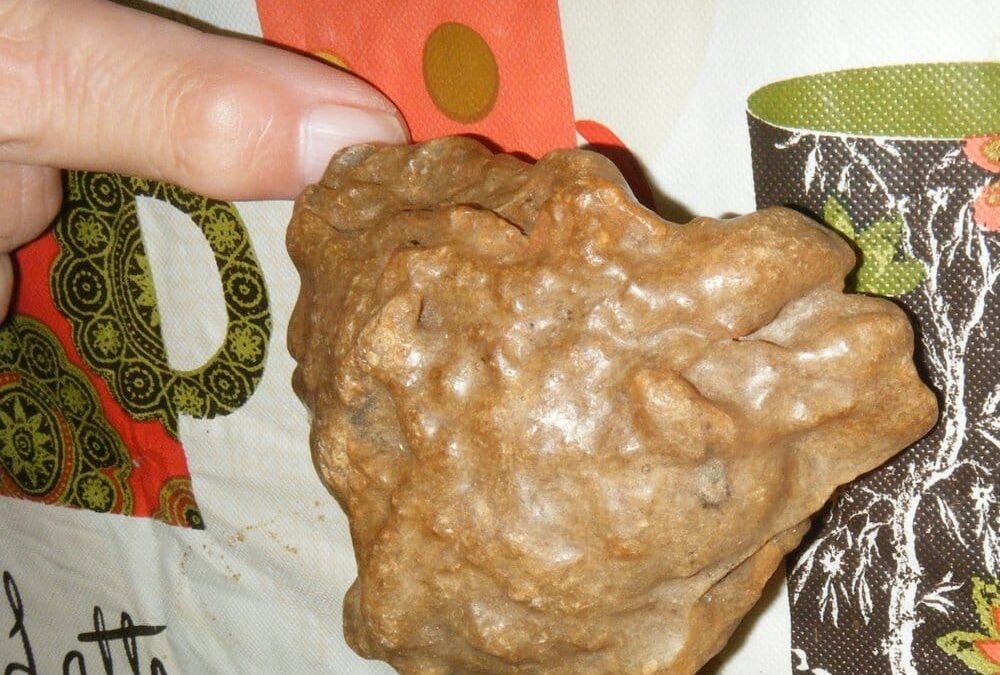

This is the photo supplied by the finder of the lump.
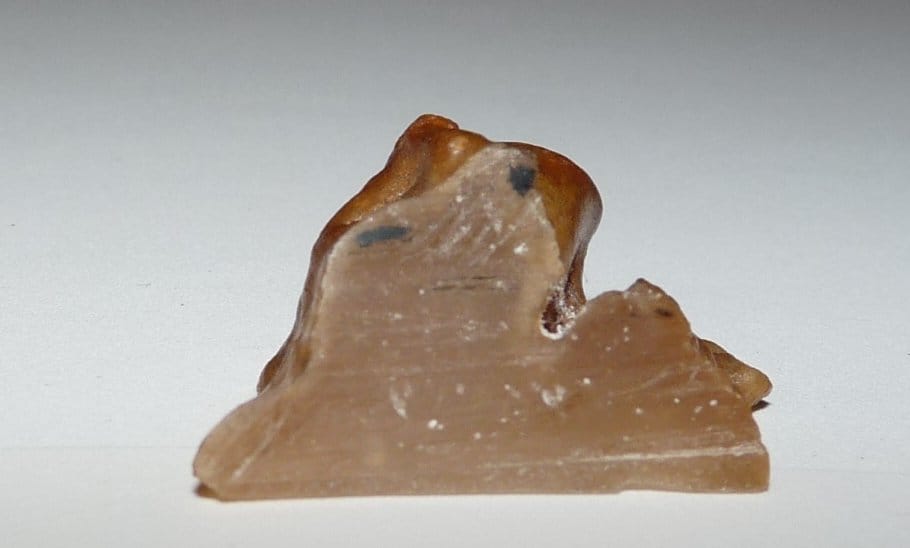
My photo of the tiny sample. They needed a hacksaw to cut it, which was the first hint it wasn't ambergris. I found out about the hacksaw after I got the sample because I asked my friend how the heck they cut it. Ambergris is *much* softer. This appears to be an agate to me.
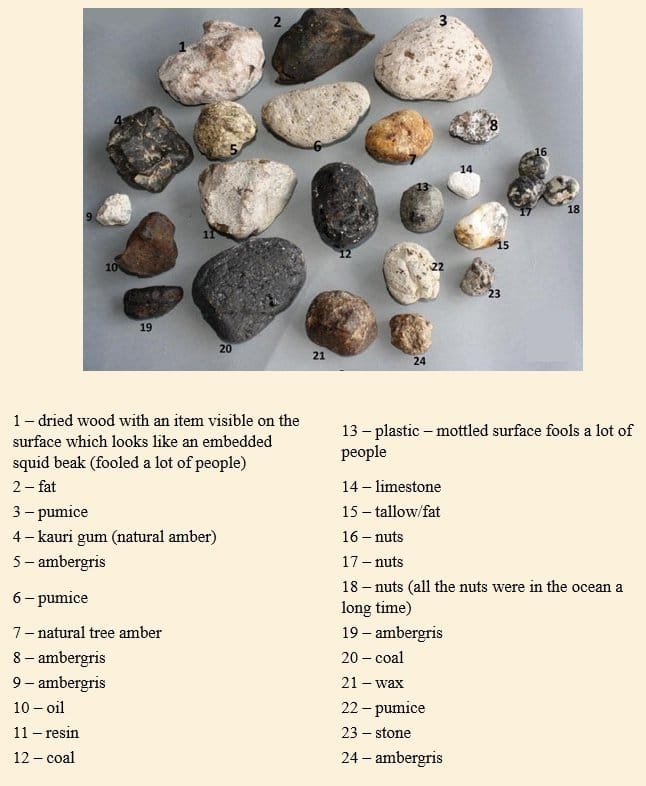 A nice visual aid that, depending upon how you look at it, will either help you, or confuse you about what true ambergris looks like.
ETA: About real ambergris: there is of course, the scent. There are many descriptors used for ambergris, among them earthy, fecal, mossy, salty, warm, balsamic, wet leaves, barnyard. Dozens more, too, depending upon the grade of ambergris. Then there's the hot needle test. Hot needle test: Heat a needle until it gets very hot. Be sure to protect your fingers, perhaps use a piece of something as a barrier on the end you're holding it. Touch the needle to the lump you suspect is ambergris. Ambergris' surface will melt instantly, and form an oily black mark and give off a tiny puff of smoke that has a definite scent. Ambergris will float because it's lighter than water, but don't left it sit in water, it will absorb it. Ambergris loses some weight over time, so if you have a chunk for a year or more, it should show some weight loss (due to moisture evaporating).
ETA2: A visitor asked how to make a tincture, and I realized I should have included that information in the post. Here's my reply:
I’ve never heated my tinctures, and I don’t believe that's a common practice. I do use a stirrer intermittently ( when I remember to turn it on as I leave the room since the noise is annoying). The old contraptions that constantly rotate the big bottles of ambergris and other tinctures were a mainstay in French perfumery houses. I’m sure they have an updated version now. I never remember reading or hearing of heat with them, either. I see no reason to speed the process. I’m sure it could be done with something like an ultrasonic, but I’m old school about some things.
To make a tincture: Weigh your piece of ambergris. Weigh out 190-proof alcohol that will then create a 3-5% tincture. If your piece is particularity soft/gummy or hard, it helps to add a bit of sand and grind in a mortar and pestle. I often use a microplane grater. When your ambergris is pulverized/grated, add it to a bottle (even if you added the sand, put that in, adds to the marine theme), add the alcohol, shake to mix and if you don’t have a mixer, try to remember to shake it daily for six months. Of course, use a good cap to keep out air. Some say add a bit of alkaline if you believe the ambergris may be acid, but I’ve never done that. After the maturation process is over, I carefully pipette some of the liquid for use, and I leave the original ambergris/sand in the bottom of the bottle. Some may strain it, I don’t, and I have gorgeous various vintages, all still beautiful and usable.
I'll be here until 10 PM tonight, ET, so please leave your comments before that to be in the drawing for the sample of ambergris tincture and a tiny piece of ambergris.
A nice visual aid that, depending upon how you look at it, will either help you, or confuse you about what true ambergris looks like.
ETA: About real ambergris: there is of course, the scent. There are many descriptors used for ambergris, among them earthy, fecal, mossy, salty, warm, balsamic, wet leaves, barnyard. Dozens more, too, depending upon the grade of ambergris. Then there's the hot needle test. Hot needle test: Heat a needle until it gets very hot. Be sure to protect your fingers, perhaps use a piece of something as a barrier on the end you're holding it. Touch the needle to the lump you suspect is ambergris. Ambergris' surface will melt instantly, and form an oily black mark and give off a tiny puff of smoke that has a definite scent. Ambergris will float because it's lighter than water, but don't left it sit in water, it will absorb it. Ambergris loses some weight over time, so if you have a chunk for a year or more, it should show some weight loss (due to moisture evaporating).
ETA2: A visitor asked how to make a tincture, and I realized I should have included that information in the post. Here's my reply:
I’ve never heated my tinctures, and I don’t believe that's a common practice. I do use a stirrer intermittently ( when I remember to turn it on as I leave the room since the noise is annoying). The old contraptions that constantly rotate the big bottles of ambergris and other tinctures were a mainstay in French perfumery houses. I’m sure they have an updated version now. I never remember reading or hearing of heat with them, either. I see no reason to speed the process. I’m sure it could be done with something like an ultrasonic, but I’m old school about some things.
To make a tincture: Weigh your piece of ambergris. Weigh out 190-proof alcohol that will then create a 3-5% tincture. If your piece is particularity soft/gummy or hard, it helps to add a bit of sand and grind in a mortar and pestle. I often use a microplane grater. When your ambergris is pulverized/grated, add it to a bottle (even if you added the sand, put that in, adds to the marine theme), add the alcohol, shake to mix and if you don’t have a mixer, try to remember to shake it daily for six months. Of course, use a good cap to keep out air. Some say add a bit of alkaline if you believe the ambergris may be acid, but I’ve never done that. After the maturation process is over, I carefully pipette some of the liquid for use, and I leave the original ambergris/sand in the bottom of the bottle. Some may strain it, I don’t, and I have gorgeous various vintages, all still beautiful and usable.
I'll be here until 10 PM tonight, ET, so please leave your comments before that to be in the drawing for the sample of ambergris tincture and a tiny piece of ambergris.
Wow Anya, all the pictures are quite fascinating! I don’t think I will ever see real ambergris in my life but it is very educational to see how confusing it can all be =)
I loved the story..it is confusing to look at all of the photos…rocks, nuts, etc. I have an old chunk of ambergris that I received and made into a tincture..it smells great.
I would love to sample yours.
How long do you think you need to keep the ambergris in alcohol before it is ready and smells good?
Hi JoAnne:
Ambergris tincture needs to be aged at least six months before it develops its full potential and scent. It gets better with age! Whenever I made a new batch, I always put a little from a former batch into the mix.
xoxo,
Anya
I am so very curious to get to know the real deal. I have always loved scents with amber & amber accords. Thank you for sharing the information and the photos.
Hi Anya!
I just love ambergris (when used wisely in perfumes) and the real deal is so so hard to find ANYWHERE! Thank you so much for giving us such amazing visuals on this extremely elusive and gorgeous perfume material…
The Peabodyy Museum in New Haven (http://peabody.yale.edu/), used to have (maybe still do) a huge lump of Ambergris (double fist size), I remember it being displayed behind glass in a stairway with an “open the little door and smell” sign. I think it was originally part of a history of Connecticut whaling exhibit.
HI Scott:
Thanks for stopping by. It makes a lot of sense that a whaling exhibit would have a sample. How cool they had a ‘porthole’ for smelling the chunk. Tincturing some of the chunk and making that scent available would show the transformation.
Anya
Thanks for the photos. I always keep my eyes open when at the beach and soon headed to Mexico and a beach that gets flotsam from world over and hoping to find something worthwhile!
WOW. I never imagined it will look like that.
Like a rock or a peanat butter candy 🙂
Looks yammi……….
Dear Michal:
Don’t confused the first photo that looks like glossy peanut butter, that is the agate. Rock, grey pebble, dark brown lump, yes, there are many disguises!
Thanks for stopping by,
Anya
Oh wow; I have never seen (or smelled) “real” ambergris, I can see how it is hard to find from your comparison photo!
Anya-correct me if I’m wrong but once you got the sample from your friends-couldn’t you tell straight away that it wasn’t ambergris because it didn’t smell like the real thing? Or does the scent only flourish once it’s been tinctured?
Hi Simone
I replied earlier but the database at godaddy the server crashed, and I guess it got lost. Yes, the fact that the rock had no scent was paramount. Ambergris lumps will have a scent.
Anya
I bought a 3 gm piece of ambergris from a guy named Matt Turner in New Zealand. Maybe he sells his ambergris on eBay, but I found him through a thread on Basenotes. Here’s the piece he sent me: http://s1192.beta.photobucket.com/user/mattybaba/media/AMBERGRIS%20FOR%20SALE/8-1.jpg.html
I took 1 gm and mashed it up in my mortar and pestle. It made quite a mess because it was gummy more than crumbly. I then “washed” the whole thing into a jar with about 12 ml of 95% ethanol. Now it sits in a cupboard. I shake it once every few weeks if I remember. A smell strip dipped into it smelled pretty much like nothing in the first weeks. That was in May of 2012. Today, 7 months later if I dip my smell strip in, I get the ever so slightest smell of distant beauty, but not much, and it goes fast. Also, a waxy film is left on the smell strip.
So my question is: how long does it take, and what do you recommend to speed the process? On the main Basenotes discussion about this, in the DIY section http://www.basenotes.net/threads/311637-Ambergris, Chris Bartlet recommends heating to about 30 C and stirring constantly 24 hours a day.
My question to the perfumer is: what do you recommend as the best way to create an ambergris tincture?
Dear Barry:
Looks like a white/silver piece, nice light scent perfect for floral perfumes. IIRC, we’ve corresponded in the past about the scent of ambergris. It can range from faint to semi-strong, and the beauty isn’t so much in the scent, but in the magic the aged tincture performs in a perfume. It marries and exalts the other aromatics, if I could use an image, it weaves its scent molecules in among the other aromatics, uniting them. Distant beauty is perfect, your tincture sounds divine. I don’t remember a waxy film with mine, but it’s possible.
I’ve never heated my tinctures, and I don’t believe that’s a common practice. I do use a stirrer intermittantly ( when I remember to turn it on as I leave the room since the noise is annoying). The old contraptions that constantly rotate the big bottles of ambergris and other tinctures were a mainstay in French perfumery houses. I’m sure they have an updated version now. I never remember reading or hearing of heat with them, either. I see no reason to speed the process. I’m sure it could be done with something like an ultrasonic, but I’m old school about some things.
To make a tincture: Weigh your piece of ambergris. Weigh out 190-proof alcohol that will then create a 3-5% tincture. If your piece is particularity soft/gummy or hard, it helps to add a bit of sand and grind in a mortar and pestle. I often use a microplane grater. When your ambergris is pulverized/grated, add it to a bottle (even if you added the sand, put that in, adds to the marine theme), add the alcohol, shake to mix and if you don’t have a mixer, try to remember to shake it daily for six months. Of course, use a good cap to keep out air. Some say add a bit of alkaline if you believe the ambergris may be acid, but I’ve never done that. After the maturation process is over, I carefully pipette some of the liquid for use, and I leave the original ambergris/sand in the bottom of the bottle. Some may strain it, I don’t, and I have gorgeous various vintages, all still beautiful and usable.
Thanks for asking,
Anya
Great post, Anya! I LOVE amber, it is an integral part of many of my most cherished scents. And the pics?! Thanks!
Now, I have a question: Do you think it is worth the trouble to attempt to recreate one’s favorite scents utilizing natural ingredients? (I’m becoming more conscientious of what I put on/in my body and environment.) For instance, I’m OBSESSED with Issey Miyake’s L’eau Bleu and Donna Karan’s Fuel for Men (originally DK Men,) Should I even bother attempting it? I’d love to know your opinion. Thank you!
Dear Ariel:
I don’t think re-creating a perfume that contained synths with natural materials is possible, and my opinion is officially “feh”! But, of course, I’m biased and while I understand your obsession/love of certain scents, I’m so won over, and have been, for decades, by the naturals, I never even give synth perfumes a thought. Well, I did a week ago, when I opened a vial that was sent to me by someone who shall remain nameless, of their new perfume. A few drops sprayed onto my index finger and thumb as I pulled the plastic stopper out, and not only did it smell like so many other synth perfumes out there, it was a scrubber that refused to be scrubbed off for hours. Ok, rant over!
I wish we had a cute slogan for natural perfumery. “Once you go natural, you’ll never go synth”. Nah. “The world is natural, and so are our perfumes”. Nah. Any ideas, anyone?
Sorry for digressing, sending best wishes your way,
Anya
Anya!
Thanks for your reply (I feel super special, now!) and don’t apologize, digressions lead to better conversations! I thought I loved amber because I loved the Amber Pour Homme that my brother gifted me from Prada; but when I had the oportunity to smell the real thing in the form of a beautifully rich tincture… Well, let’s just say I felt like I hadn’t seen nothin’ yet!
Thanks again for the swift response. I think you’re right about recreating synthetics.
Have a great Sunday!
Ariel
It is amazing how fascinated we are by the romance and mystery of whale vomit. There always seems to be a bit of gold-rush fever alongside the curiosity too, like Anya noted.
Long before I was interested in perfumery, I was still enthralled by stories of ambergris. I recall one story I read where ambergris was mixed into the paint for a hall for some emperor’s castle, with the scent lingering for decades.
I am so curious myself. I wonder how does the smell of the black ambergris differ from the other pieces?
Dear Jojo
black ambergris is quite more fecal, funky. Still, it was recognized by Arctander as having worth. It can also be dessicated/aged a bit by using food grade silica.
Thanks for asking,
Anya
Wow – I can see how this could be very, very confusing.
Anya,
It is very interesting to me how ambergris comes in the different colors you show. I’ve never seen or smelled ambergris before, and would love the chance to have a sample of it.
Renee McCleary
Dear Renee:
See my message to Eileen, another student. You’ll both be in the random drawing here, too. BTW, I believe you’re both from Israel, right? I have about six Israeli students, some now living in the USA.
xoxo,
Anya
PR
Oh I would like to win this time to examine and learn about Ambergris.
Dear Eileen:
Thanks for stopping by. I always have an ambergris once a year for students! It’ll be announced in the private student yahoo group and it’s for 4mls.
xoxo,
Anya
thank you so much for these mini-lessons! we all appreciate you sharing your vast knowledge with us.
So sweet, Anita. BTW, you were acknowledged in the letter that went to the recipients of the Perfumers Relief Aid packages for your contribution. xoxo,Anya
Great post Anya. I remember seeing this photo on the group. It is and can be confusing for sure. What is considered to be the saturation level of Ambergris in a perfume? Thanks!
HI Sandi:
Saturation is a term I wouldn’t use, but I know what you mean. To me saturation would be someone who overdoses the ambergris. I’ve never used more than 3%.
HTH,
Anya
Awesome post, Anya! And I am loving these reader questions and comments. I can’t wait to learn more about ambergris!
Hi, Anya, thank you for the offering!
Can you tell us also how much does ambergris cost and where can we buy it from a reliable supplier?
Dear Florientina:
Look at some of my recent replies and some posts by others and you’ll find the approximate costs and suppliers. Closest to you would be profumo.it in Italy.
xoxo,
Anya
PS did you ever review my perfumes? I may have missed it, as last year was very stressful for me.
Thanks for the reply, Anya!
I will check Profumo’s ambergris.
Yes, actually I wrote the review about the three perfume samples from you, and the boronia absolute too, in my notebook :). I didn’t post it yet, I wanted first to send the review to you, the approve it :).
…But I started school and got busy with the exams. I haven’t posted anything for a long time.
I will send the review to you soon, to tell me what you think of it. It will be my first one for this year.
You know these ancient “animalistic” scents are such a dilemma for me…..I love florals so much and when you add them to these there just seems to be some big clash like a flute being played in the middle of a High School marching band! But people go on about how these can augment that floral quality and such and it just ends up irritating me…..I recently stopped using oakmoss because it just was too strong but I still LOVE Vetiver after it does its odd sweetening trick (in about an hour after contact with the air or so?) and sweet sandalwoods are my passion. This, civet and colostrum are the last three big base note fixers I have yet to see if they drive me crazy or somehow work….I recently got some attars that had such a strong animalistic note to them (they were musks using cyperus and such to get that note going) I had to get rid of them-they were practically screaming at me through their bottle!
I wonder of all the ambergris if there is a really light soft version that I might like? We shall see!
If you are wanting a lighter, softer floral that still reflects some oceanic qualities, you want to start your tincture with a pale gray-silver piece or use a finished tincture labeled Sweet Marine. Otherwise a White-Gold tincture would be the best to compliment and not add to a mix. Ambergris is one of the most fascinating natural products to work with and not beyond mastery.
So true! Thanks for stopping by Gregg.
Dear Matthew:
First, let me say your gardenia pomade is being mailed tomorrow. I got very behind in shipping out the Winter Solstice prices. You’ll find it beautiful but not very long-lasting, since it isn’t fixed with anything. It’s made with organic nonhydrogenated palm shortening, and it is hard when cold, and nice and soft when warm. Have fun!
It’s obvious you’re sensitive to the powerful accessory notes, vetiver excepted. You might try a 1% of the others, what I call a sheer backdrop. Balance is key, the flute can have a nice solo, you know?
You would love a white or silver, I’m sure. Frans and Adrienne may have some.
xoxo,
Anya
Hi Matthew
I posted a long reply to this, but godaddy ate it when the database crashed. Short version: learn to really dilute down the stinky stuff, it will give a sheer backdrop effect. Keep up the search for light, bright ambergris, it does exist. Sounds like Barry got some.
xoxo,
Anya
The going rate for good ambergris — an actual lump, not tincture — is US$25/gm. So the little piece that I bought from Matt Turner was $75 plus shipping. Many people charge more. And people charge more for better quality ambergris. There’s a whole spectrum from the fresher black fecal kind to the exquisite white fresh baby’s breath kind.
Barry, I haven’t checked recently, but I think Frans and Adrienne have it a bit cheaper, and IIRC, they include shipping. I think profumo only sells the tincture, so a customer would have to work out the math. Still, a nice bit of either chunk or tincture could be had for about the price you quote.
Thanks,
Anya
I’m officially an ambergris addict, if that’s at all possible! I’ve even had phantom scent episodes where I think I’m smelling it. It all started after I won some ambergris when that photo was posted in a Natural Perfumery Group challenge. I now can’t imagine life without it! Lucky you that you have had so many years of experiencing this exquisite and complex scent. I would love to try your sample and thanks for the offer. That lump of agate posing as ambergris is hilarious.
Hi Maggie:
Yes, I remember you winning some! That was a nice brown/tan ambergris you won, IIRC. The funniest part of the ambergris/agate vetting was me tapping it on my front teeth. I just had to, don’t ask me why, it just cracked me up!
xoxo,
Anya
Ah! Ambregris! I wish I could smell it some day! What I read about it makes me dream!
If you know some RELIABLE source of GOOD QUALITY ambregris, please tell me!
(whispering: of course I hope i’ll win Anya’s giveway but… )
Hi Isayah:
Profumo has been mentioned, I’ll second that. The fellow in NZ sounds like a good source, but I’ve never dealt with him, Barry has. There Frans and Adrienne at ambergris.co.nz and they’re good sources, too.
HTH,
Anya
Thanks Anya! it is really great to read your posts and share thoughts and questions. To me it is invaluable! I hope some day I can reciprocate, I can’t see how yet but… Who knows what future might bring?
This is such an interesting post Anya! I love it. I have never been able to smell real ambergris in it’s raw state but only as a tincture. I am interested in smelling it since the smell varies so greatly in description. Despite what some would imagine to be an offensive aroma based on the mental picture I bet it smells lovely. I favor earthy and you had me at marine…Thank you for the awesome information!
I got a gram from Profumo a while back and I treasure it like gold. My working description of ambergris is “a wooden chest covered in barnacles, soaked by the sea but drying in the sun”
Despite, Isn’t it true that the purpose of
Ambergris is not to lend a scent of its own,
But to change the interaction of the other ingredients? And that just one drop in an
Ounce would do it? Or do you find that it lends an actual marine note?
Hi Matthew:
How are things in No. Cal today? Hope you’re enjoying life. Nice description! Ambergris is not supposed to, well, that might be a slight stretch, to impart its own scent, but yes, some perfumers do use it for that purpose. In other words, an overdose is fine, if that’s what the perfumer intended, but only a tiny amount is necessary to exalt a perfume. I would use 3% of that 3% tincture no matter what the quantity of perfume. Some ambergris don’t have a distinct marine note, they can vary a lot, as discussed elsewhere in teh comments.
Take care,
Anya
White or Silver…got it! I figured there would be a lighter version of sorts…maybe because the cuttlefish eaten were from a certain season, the whale was younger or older…had brushed its teeth that week…who knows?!
What an interesting post, I’ve never smelled real ambergris or even seen it, I think I’d walk right by a little black lump on a beach!
I have always been fascinated by ambergris, living on an island with many kinds of whales passing by. Unfortunately, not the kind that produces ambergris. I appreciate the tidbits of information!
Lucy, it’s my understanding, that ambergris can wash up anywhere. True, the odds aren’t in your favor, but after a big storm, you might have a chance that some washed up!
I have always dreamed of walking along a beach and finding a huge chunk of ambergris. Now I know for sure that it is extremely difficult to distunguish it from ordinary flotsam! I also was very interested in the hot needle test. ( I love reading your posts!)
Thanks for the compliment, Rae Lynn
I see there are people here who have never smelled ambergris as well as those who have ambergris and have used it in various ways. Maybe some of us could describe our experiences for those who have never tried it.
I have two experiences. Dominique Dubrana of http://profumo.it sent me a couple millilitres of his 3% tincture. And I have a lump from Matt Turner as described above. The profumo one is indeed like “a wooden chest covered in barnacles”. Funny, because the way I describe mine is through the memory of an old cigar-smoking, card-playing uncle from the 1950s, whose coat had that smell. Maybe he used a popular fragrance for men of that period that was ambergris heavy. Or maybe my uncle was a “wooden chest covered in barnacles”. My understanding is that this rougher, dirtier, more fecal smell of ambergris is characteristic of younger samples, probably less than 10 years floating on the sea.
The older gold and white samples develop the smell described by Arctander: “its odor is rather subtle, reminiscent of seaweed, wood, moss, with a peculiar sweet, yet very dry undertone of unequaled tenacity.” That’s what my incredible little white lump from Matt Turner smells like.
Anyone can buy either a tincture such as profumo’s or a lump such as Matt Turner’s for under $100. As a life experience, I would say go for it, it’s worth it. Great conversation piece for parties and guests, too.
Dear Barry:
I agree with everything you wrote!
xoxo,
Anya
Anything that fascinates and excites people s much s ambegris has a magical quality. Unlike platinum or diamonds, there is a real chance that you could actually find some. OK, it’s a really tiny chance, granted.
I am fascinated by this elusive product of the whale. I don’t believe that I have ever smelled it but my goal in life is to do so, hee hee. You post makes me want to wander the beaches in search of a tiny chunk of treasure, and with your wonderful description, I almost feel as though I could find one. Hey, I can dream.
The idea of stumbling uon a piece is so romantic and exciting to me, but I would be thrilled to have a tiny amount tinctured to treasure and swoon over. I am afraid it might turn me into a mermaid, or worse yet, an ambergris addict, as Maggie said. Hey, there are worse things in life.
Q: Do you tincture it in it’s whole form or crush it?
Have you ever tried using a soxhlet for tincturing ambergris? I’m wondering if you might get a different profile of the scent. I’ve definitely noticed this with other (medicinal) tinctures.
No, Whelky, I stay old school with tincturing. I’m happy with the odor profile and and wouldn’t want to chance losing the transformative properties, which might happen, who knows?
Thanks for asking,
Anya
Has anyone tried the Perfumer’s apprentice ambregris? Is it good quality?
Yes it is very good quality. However, it is a particular kind. There are other sweeter ones out there. But profumo’s is worth getting. It is amazing and distinctive.
I love that picture of the different shapes of stuff and then the answers of what each one is.
I have a none ambergris question, but it is a tincturing one:
I have a orris root tincture, of pieces, not powder, at 25%, aging since June 2012,
the pieces are still in the alcohol, would you recommend I leave them in, or take them out?
it is a very large ammount of tincture, and I am comfortable taking from above small ammounts to use, and figure the aromatic material may have more to add…?
an ambergris question: do you use it in Royal Lotus?
and have you tryed ambergris absolute?
Hemla
Dear Hemla
Keep the tincture of orris going as long as you want. I have some 10 years old, and I leave the powder in the bottom. Yes, ambergris is in Royal Lotus.
Take care,
Anya
The photo of rocks was fun, I did pick the ambergris out correctly but I am sorry To say I have yet to see and smell a real piece of it……….I would love to know your source for true ambergris and many thanks for a very gracious draw!
Hi Joyce:
I have a number of suppliers, they change all the time. I would be wary of the ones on ebay, although Barry wrote he got some good stuff there.
Thanks for stopping by!
Anya
Wonderful discussion about the elusive ambergris! I would love a chance to smell and work with the real thing. I have the same question as Simone – can you not tell that you have ambergris in your hands by smelling it? I dream of beachcombing for ambergris someday…. Thank you for sharing your wisdom, Anya!
Great article and picture of the ambergris with other items 🙂
Your post and all these relies are fascinating!
I recently made an ‘ambergris!’ accord from a recipe supplied by a natural perfumer so I could finally get a sense of what it smelled like. Tho I’m sure nothing like the real thing for lack of aging and the marine element and mainly it’s just sweet and a bit smoky. It would be amazing to smell the real thing!
I so appreciate your expertise and generosity Anya! Thank you
AH ambergris! No wonder identifying ambergris is so hard, in that photo, the real ambergris looks like most everything else in the picture. Every time I go to the beach, I wonder if I’ll find some, especially after reading Floating Gold; A Natural and Unnatural History of Ambergris by Christopher Kemp. I have some ambergris tincture that I got from Profumo(along with civit, castoreum, beeswax, and hyraceum) and the first time I smelled it I honestly was not impressed. The opening had a mildly sweet, vaguely floral-like quality, but then it moved into this animalic musty thing, like horses, barns full of hay, and old musty attics. I was rather disappointed(at first), However with aging it has gotten much, much nicer and sweeter. I’ve had it for a few years now and the floral-like ‘top note’ is still there but the animalic, mustiness has mellowed into a really pleasant ‘hair and skin’ sort of smell. But even though I was not keen on the smell at first, I did use it in blends and when they say it is magical in a blend, they are not exaggerating, it makes a perfume a perfume. I also think this about civit.
I was wondering, when you make a tincture, what do you do with the old ambergris solids left over? I’m thinking about getting some of the actual ambergris someday and making my own tincture. I remember you saying that ambergris macerated in coconut oil is deliciously ‘naughty’ as I believe you put it. I’d like to try that too.
Hi Brian:
Yes, I leave the ambergris in the bottom of the jar forever. Some may disagree, but I have not observed any negative facts about it, in fact, I think it’s luscious, and then when I make a new batch, I put some of it in the new jar.
xoxo
Anya
Hi! Thank you for your article and draw! I will have to keep the hot needle test in mind in case I ever get so lucky as to come across some.
So I have seen references before about various colors of ambergris… are those real or just perfumer’s descriptions? If they are real… how do they come about? Is each piece of ambergris unique in scent to the whale, or is it more about its journey after being excreted?
Hi Tatavia:
The color variations can be caused by the food source, the stomach and intestine flora, blood (which can look like striations) and the amount of sun and salt water exposure. I can’t answer all your questions, because experts have been wrestling with them for centuries. There’s a lot that’s unknown.
HTH,
Anya
How very generous of you to share such a rare substance. I would love to sample ambergris someday. Yay for the lucky winner!
Really useful article about how to detect ambergris, thanks for sharing!
i suppose it’s too late for the drawing, but it’s a lovely and informative article
Really interesting article and photo Anya.
I especially appreciate all the comments too.
I would love to experience ambergris in the future.
It’s on my new bucket list.
Thanks for the picture of ambergris ID. I hope to find a piece on the beach one day 🙂
Thanks you for an interesting and educational article and photos, Anya!
It was so fun reading everyone’s posts and your replies, Anya.
I Just wanted to add how much I appreciate your generosity in sharing your knowledge and for these precious pearls of wisdom.
Hi Everyone:
Sheree Tompkins was chosen at random for the win! Congratulations, Sheree, you ambergris tincture and piece of ambergris will be mailed to you. Please email me your address privately.
To all the readers of this blog: I will be blogging, with photos and descriptions, about my various grades of ambergris. Make sure you’re subscribed to my blog posts so you don’t miss it. I’m also going to be blogging about the perfume creation process this year, and I think you will enjoy that!
Best Wishes,
Anya