
Ask the Perfumer - and an Ambergris hypothesis
Guild member Lisa Coburn posted a link on Facebook that took me to a video on how cephalopods--squid, cuttlefish and octopus, are masters of disguise. As I watched it, I made a perfume connection, straight to the elusive, mysterious, rare and valued ambergris, a gorgeous material used in perfumery.
 |
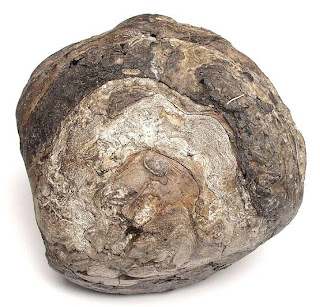
| Photo of the famed 'Yeti' chunk of ambergris. |
Ambergris is produced by the stomach/intestinal secretions of the sperm whale to protect its insides from the sharp beaks of the squid and cuttlefish, two main items in its diet. The whale evacuates the chunk of ambergris when it becomes large enough to be an irritant on its own, albeit a softer, rounder irritant compared to the beak and cartilage of the squid or cuttlefish. As a perfumer, I often have to gently remind excitable newbies 😉 that the scent of the ambergris is secondary to its major contribution to a perfume, which is its ability to 'marry' and allow the other aromatics in the perfume to coalesce into a beautiful 'one'. Well, 'one' isn't a common term used, unless you're thinking of a seamless perfume, one with no 'stepped' drydown.
After viewing the video, linked below, try to follow my line of thinking. Just an hypothesis, and one that makes sense on an intuitive level. The same 'blending in', 'camoflague', or 'marrying with the surroundings' attributes that we give to ambergris is already obvious when the squid or cuttlefish is alive. Perhaps there is something inherent in the DNA of these creatures that gets transferred to the ambergris, sharing the same properties?
Just a thought.
Any questions about ambergris? Do you think I may have hit on something? Oh, last week's winner of the eight-year-old ambergris tincture was Leann of Trinidad, Colorado, and it's on its way to her. I suppose I'll have to have another ambergris giveaway today, given the theme of the blog. Leave a question or comment and you'll be in the drawing for this mysterious, gorgeous substance!
Here's the video - be prepared to be astonished https://sciencefriday.com/video/08/05/2011/where-s-the-octopus.html
So curious to knoe the history was it in Europe at the time of the fall of Rome?
B Simmons
Hi BBI
Not sure of that part of the history. There certainly was ambergris available, since it is a natural product from the whale. I do remember many stories of eating and drinking it in France a few centuries ago. It’s been used for scent for centuries, also, remember the Sergeant painting? Tincturing it in alcohol didn’t occur until alcohol distillation was discovered in what, the 11th century? Then somebody had to observe the aging, and then using with essential oils/absolutes.
HTH,
the non-historian,
Anya
This is a really interesting hypothesis. Speaking as someone who is a fairly good social chameleon by nature, this is one idea I definitely want to test someday.
Hi Eridan:
Glad I piqued your interest.
🙂
Anya
Hello Anya, Thank you for your interesting ideas on ambergris. What percentage would you use in an eau de parfum?
I used it in a custom perfume but not for my commercial lines.
Thank you.
JoAnne
Hi JoAnne:
The % depends on the perfume/edp. It’s best with light florals, of course, and another animal essence, like civet, musk, hyraceum, goat hair.
HTH,
Anya
such a cool video!!! thanks for sharing Anya. I’ve never had the pleasure of using any ambergris for my perfumes, but I’m sure it would definitely bring something a bit mysterious and magical to any blend. 🙂
Hi Candice.
Glad you enjoyed it. I have to give Lisa C the credit for sharing the video, and then my imagination went into overdrive.
BTW, I forgot to write in my previous responses, all who post a comment will be in the running for the ambergris tincture.
xoxo,
Anya
Amazing phenomenon captured in the video – wow. I like your theory that adaptive qualities could be carried in DNA. I’ve no direct experience with ambergris at this point, but from reading about it, there’s certainly an analogy in how it behaves within its surroundings. What a fascinating substance.
(It reminds me of how the unfortunately toxic MSG mysteriously boosts umami flavors in nearly everything.)
Andria
Hi Andria:
Glad you found it interesting, we’ll need to see if anybody follows up to prove or disprove my theory.
MSG isn’t toxic to everyone, btw.
xoxo,
Anya
This is the most fascinating aspect of perfumery to me. I have never smelled ambergris, but I guess it’s not so much how it smells, but rather how it interacts or marries that makes it so prized, it’s transformative nature.
On another note, I have a quick question, Anya. I am wondering how you recommend to “research” a perfume name, so as not to accidentally steal a name that is already being used? This might be something I should post on the forum, but it’s kind of a sticky subject. And also how would you handle it if you found out someone was using the name you chose for a perfume.
don’t think names are copywrited, unless trademarked
Hi Debulous:
You can go to the USPTO website (google it) and do a search. Even then, you’re not sure until you submit the name for trademark, if that’s the way you want to go. Want to read something interesting? http://anyasgarden.blogspot.com/2009/08/more-trademark-silliness-squatting-on.html
lol,
Anya
did not know that about ambergris….fascinating stuff. I’ll have to work with it sometime…
You know there really are so many things going on with this concept-the recognition of the object, the consideration of the photons and such effecting the color, the shape that is mocked….I’m wondering what sort of electro-chemical process is going on, to say nothing of with DNA! I wouldn’t doubt if there is some very basic protein structure that is a building block of this ability and behavior that somehow carries over into the ambergris…what a great leap of abstract thinking! A biochemist needs to answer this one…or the Science Friday people (I love that show!).
Hi Matthew:
It would be an interesting investigation. Science Friday is fun!
thanks,
Anya
You know there really are so many things going on with this concept-the recognition of the object, the consideration of the photons and such effecting the color, the shape that is mocked….I’m wondering what sort of electro-chemical process is going on, to say nothing of with DNA! I wouldn’t doubt if there is some very basic protein structure that is a building block of this ability and behavior that somehow carries over into the ambergris…what a great leap of abstract thinking! A biochemist needs to answer this one…or the Science Friday people (I love that show!).
LOVE THAT VIDEO and Science Friday. I actually saw this vid awhile back before I was seriously studying perfumery and was fascinated, watching again and again trying to spot the octopus before it showed itself. The pattern changes were so intriguing to me as well. If a human had this ability they could qualify as a superhero! As it relates to the marriage of smell, perhaps the cephalopods’ DNA can be a bridge to all kinds of subtle changes in regards to material of all sorts? And it makes sense that the DNA comes through in the Ambergris.
As I write this I’m in the midst of filtering my many tincturing experiments. One being a bunch of Oak Moss I just harvested off a client’s driveway after a storm (still attached to thin branches). Having an ambergris tincture to work with would be like a dream come true! Thanks Anya
Hi Suzinn:
If you liked that video, you’ll be fascinated/cring at this one – she can’t even pronounce ambergris, lol! Oh, and she doesn’t know what end it comes out, either 😉 http://foodlawblog.foodlaw.org/2012/10/whale-barf-perfume-and-biotechnology.html?goback=.gde_4329699_member_177219590
xoxo
Anya
Hello everyone:
Today is the first low humidity (<65%) and lowish temp (<90) day since April, so I’m out in the garden. I’ll reply to everyone later. Keep those comments coming, I’m loving it.
I was on the phone with a perfumer in Chicago, and I used the analogy of GMO actually, about the squid beak/cartlidge and whale stomach secretion. The squid DNA already contained the mutable cells, the whale goo the scent, and the combined to synergistically make a new substance that has the ability to have a fragrance that stands on its own (ambergris) and yet “blends in with” the other aromatics as a chameleon.
xoxo
Anya
(actually planting some stinky onions today and weeding 🙂 )
My main education is around therapeutic use of essential oils, so I did not know the story of Ambergris until a client brought me an interesting project. My client owns a well known school of Tarot that’s been in business for 37 years and teaches the art based on Qabalistic spiritual beliefs. The Qabalah Tree Of Life is similar to the Chakra system and she asked me to create a “kit” of oils for the Tree Of Life. In researching, it turns out that Ambergris is the preferred oil for Crown (or Kether). Anyway, thought you might find this little fact interesting 🙂
Hi Wendy!
Interesting point you bring up! Yes, ambergris has been closely associated with Kether, because of it’s ability to mesh all other aromas together. Very relevant to this post; IF one is to use animal scents in qabalistic ritual. Galangal is also associated with Kether and Malkuth both, or a combination of all lower sephriot- producing the first true perfume within the Tree of Life (all others being more aromatherapeutic or simple combinations.)
Kether is also associated with Abramelin oil, which is the first and the last, comprised of differing amounts of cinnamon, myrrh, calamus, cassia, galangal & olive oil.
LOVE that you brought his up!!
Wendy and solace — so very interesting!
<3
Anya
Thank you for the interesting video. I appreciate the opportunity to learn more about ambergris, I haven’t had the good fortune to work with any as yet.
Hi Llyn
Thanks for stopping by, and good luck in the drawing!
best wishes,
Anya
There’s no science to back up any idea that somehow the DNA of the squids and cuttle fish are involved in the odour of ambergris. This is just wild speculation and is more mysticism than anything else. The smell must come from the various digestive juices and their action on the cuttle fish beaks etc, as well as the action of the sun and ocean and elements on the “whale poo” after it floats for years on the sea. I have a 3 gram piece of ambergris and it smells divine, but when I hold it and I look at it, I can’t help thinking that it’s quite similar to dog poo that happens here in Canada in the winter when dogs poo in the snow, and then you don’t see the poo until March or April when the snow melts. We used to call these newly exposed bits of dog poo “White owls” because they would be white (like good ambergris) and long like cigars, lying on the grass. Now I’m wondering if this “cured” dog poo would smell as good as ambergris. Of course I’m scared to try it.
On another note, I’ve been marinating one gram of pulverized ambergris in Ethanol for exactly 5 months, and I’m not getting any of the exquisite smell out of it, when tried on a smell strip. The actual lump of ambergris smells fantastic, but the alcohol tincture is not getting that smell–not yet anyway.
Hi Barry:
Nice to see you here! What was the % w/w with the tincture? It takes at least six months, and as I’ve been trying to tell folks for years, the scent is not overpowering. It’s subtle, lovely (although some don’t like it)and rather agrestic/fecal.
About my theory, which I prefaced by saying I was going out on a limb, not mystical, intuitive due to my rather distant, but deep study of physiology, biochemistry, and seeing how genes inserted in exogenous organisms can change them profoundly, I stick with: “Do not be absolutely certain of anything.” Bertrand Russell’s number-one commandment of teaching (and learning).
😉
xoxo,
Anya
Love your hypothesis, Anya. Ambergris indeed has a magic beyond its scent. Makes sense to me.
Hi Lisa:
Thanks for posting that link on FB today, it woke me up! 😉
For my space-diving, risk-taking ‘woman after my own heart’ – that video made me take a big leap!
xoxo,
Anya
I read in another blog from years ago that someone “tinctured” ambergris in sandalwood oil. Would you know how to do this? Does the scent of the sandalwood hide any of the scent of the ambergris?
Is ambergris tincture soluble in jojoba oil?
Thank You
Hi David:
It’s possible to macerate ambergris in sandalwood. You can use 3-4% ambergris to sandalwood by weight. Make sure the ambergris is finely ground. Shake the bottle daily. Wait six months. The sandalwood and ambergris form another beautiful scent. I macerated ambegris in virgin coconut oil, and its exquisite. I’ve never used jojoba.
HTH,
Anya
Anyone who has not experienced ambergris and is serious about perfume must get their hands on some! Save your pennies or whatever because you will be rewarded. Like Anya said, you might not be impressed with the actual scent itself; I wasn’t, but then again you might(there are many who do), but the effects on a perfume are miraculous. Interesting theory, Anya, it seems kind of like an homeopathic thing might be going on.
Hi Brian:
I don’t know if homeopaths would agree with that definition, but I see your point.
xoxo,
anya
Thank you for the video, so interesting and the shared comments here as well. Lovely to pool the knowledge this way. I love Monarch Butterfly poo! Has anyone tried it?
Hi Francesca:
Thanks for stopping by. I guess you’d have to live near a massive monarch butterfly nesting site, like the famous one in Mexico. Afraid the miniscule bits they may leave while flitting through my garden escape my powers to smell them.
lol,
Anya
Wow! Just watched the video. Truly amazing! The octopus is a true master of disguise. It’s also interesting the effect of ambergris on a perfume. I am yet to have the pleasure of comparing a perfume blend with and without ambergris. Would a GC-MS of a perfume blend before and after addition of ambergris throw any light on ambergris’ effect on perfumes?
Hi Aba:
I don’t believe a GC/MS would help in that manner. Those tests are to determine what is in something, and the percentages. Still a mystery!
xoxo,
Anya
Thanks so much for sharing you musing and inspirations along with the video! I had seen some similar videos showing their amazing camouflage abilities, but never had even thought to piece it together with the abilities of ambergris! It makes a kind of sense though, especially when peeking at it from the Doctrine of Signatures perspective about cuttlefish to ambergris.
A quick question for you, what range or ratios do you find most useful for creating resin tinctures and their concentration in perfumes? I know that too high of a concentration and it gets very tacky and can make problems with atomizers and such. But I also know that your White Smoke is a resin blend and is amazing! I find it to be a perfect ratio, where it leaves the lightest layer of resin on the skin without being all tacky or sticky.
Thanks so much Anya!
Michael
Hi Michael:
I typically do a 50% dilution of the resins, enough to make them semi-fluid so they’re easy to weigh and use. I’ll have to check my spreadsheet on White Smoke and get back to you, I don’t have it on this computer. I’m actually considering switching to EOs for White Smoke. I haven’t had any complaints about the resins, but I’m worried it may make the cap hard to remove. No complaints about that yet, either, but I’m trying to look at the long-range.
xoxo
Anya
mmmmmm, Anya, love ambergris tincture, will love to sniff yours! I’ve sprayed it in coffee (wrote about it).
Hi Lura:
Thanks for stopping by. You’re in the draw.
best wishes,
anya
Wow! Would love to smell pure ambergris. Thanks for the chance!
Hi Carlos
You’re in the draw!
🙂
Anya
Wow! Would love to sniff pure ambergris. Thanks for the chance!
I’m currently reading Floating Gold by Christopher Kemp and find the subject of ambergris incredibly exciting. I finally got around to tincturing the lumps I won on the NP yahoo group way back when . . . but have been blending with it for a while. I’m not sure if there is a connection between squid/cuttlefish DNA and the resultant ambergris acting as a blender of notes. Hmm. I think contact with salt water over time is what transforms fecal to floral. A brining process, so to speak. But an interesting thought and that video is “killer”!
Hi Maggie:
Floral in ambergris? Never came across that, even with the nine or ten samples of different colors and grades. I reviewed Floating Gold on Fragrantica – a bit ticked off that I wasn’t mentioned because I’m the one who vetted the North Carolina piece for Eden Botanicals, and turned the perfumer quoted on to ambergris for the first time in her life. At the end of the day, I’m happy with my years of experience with it and I feel I’m on to something with the squidDNA/whale schmutz connection 😉 – and the majority of the posters here feel the same way. Skepticism is good and necessary, so I welcome your comment, and wish that this topic somehow floats out there and is confirmed or debunked.
thanks,
Anya
Forgot to include the link: http://www.fragrantica.com/news/BOOK-Floating-Gold-A-Natural-and-Unnatural-History-of-Ambergris-3386.html
I’ve always loved ambergris…wish I’d been trying to get some of it when it was cheaper!
I think your hypothesis has merit. After all, a thing is the sum of its parts.
Please enter me in your drawing!
Greyson 🙂
Yes, flameelf, you’re entered. I’ll announce the randomly-chosen winner later today.
I’m not sure why my first responde didn’t post!
I think your hypothesis has merit–after all, where would the scents come from?
I love the scent of ambergris–please add me to your drawing!
Grey 😉
Wow Anya,
That was a very interesting video and an even more interesting analogy. I too have not yet experienced ambergris but would love to someday. I have some tincured musk and I understand that it works much the same way in perfume. It’s not the scent itself but how it works with the other aromatics. So, my question to you is if your hypothisis is correct regarding ambergris, how would that carry over to the other aromatics used not for their scent but how they interact with other scents much in the same way as ambergris? I love learning….one question always lead to more questions! ;~)
I would love to be entered into the drawing and maybe I will be lucky enough to try some ambergris before I can actually afford to buy some….
All good things,
Sheree
I have never smelled pure ambergris, but it continues to be one of the most mysterious and fascinating perfume ingredients for me. I could read endless blog posts about it. 🙂
I have never smelled pure ambergris, but it continues to be one of the most mysterious and fascinating perfume ingredients to me. I could read endless blog posts about it. 🙂
I would love to smell your ambregris tincture, and see/smell how it reacts to other perfume materials.
Thank you for all these interesting informations and also for the amazing draw.
I’ll keep my fingers crossed!
Good luck, Isayah!
Hi Anya,
Thanks for all that you share & the community you create.
I’ve never smelled ambergris, but would like to as part of my aroma-education.
Rick
Good luck to you, too Unknown.
My completely unscientific, yet random method of closing my eyes, scrolling up and down the page, and then hitting the keypad turned up Lura Astor as the winner! Lura, go to https://anyasgarden.com/contact.htm and send me your mailing address.
Anya…such a prescient observation to make!!! It’s probable that because you know ambergris as a perfumer you were able to make this connection as no scientist ever could have! What an amazing connection & a phenomenal video! Please keep us all updated with the latest, greatest info on ambergris in your blog & thanks for the giveaway!
I love the idea that there is a type of connection between one aspect of an ingested creatures performance on the secretions of a mammal in dealing with it… Ingenious and improbable but nevertheless intriguing. Never say never. If nothing else, it is a lovely name or theme for a perfume. Please count me in for fun?
This video was amazing and yes I think your connection was spot on. I see ambergris as a mail man or delivery person, a connector of sorts. I’m a bit confused as I thought ambergris was illegal to own, I saw it on a T.V. show. I couldn’t swear 100% but I’m pretty sure. I would love to be the receiver of the giveaway.