
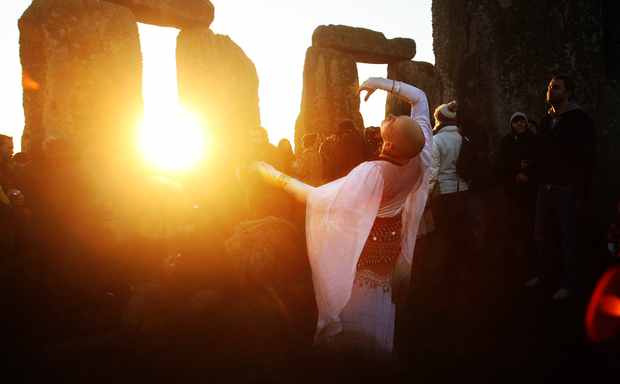
Winter Solstice Pagan celebration at Stonehenge
We have to thank the ancient Pagans for the custom of bringing cut evergreen trees indoors to celebrate at this time of year. Dating back centuries, the evergreen tree was the symbol of life in the middle of the cold, dark winter when most of the plants and trees had lost their leaves. The Pagan religion is not as well-known, funded or establishment as many of our 'modern' religions, but it predates all of them, at least as we recognize religions in Europe and the northern hemisphere that stretches across that continent into Russia.
Paganism is derived from the Latin paganus, meaning rustic person or country dweller. It's a polythestic religion, with worship of many gods and goddesses. From ancient Greco-Roman times, paganism was indigenous in Europe, Africa, Central Asia and Australia. Other religions, often called folk religions were recognized in China and Africa, and in modern times, neopaganism is reflected in Wicca and Neo-Druidism. As you can see, the scope and definition, under the broad term of paganism, can be complex. I'm not a scholar of this, and for the Winter Solstice blog, with focus on the subject of nature and how it lives on to today, reflecting Pagan rituals.
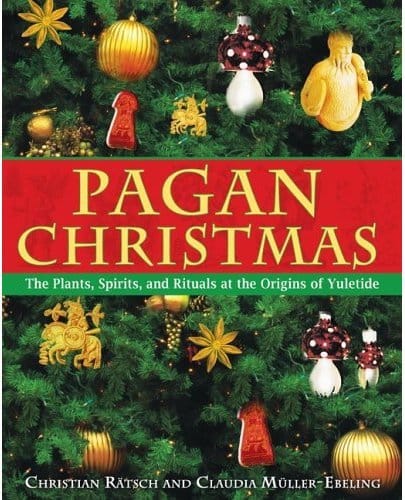
Lovers of nature and followers of the nuances of change in the world of nature, the Pagans were waiting for the lengthening of the days that comes with the Winter Solstice. Their agrarian culture was often at the point of starvation during the long winter, except for the slaughtering of farm animals. Greenery, light and fragrance were rare in the Winter. When the evergreen trees were brought indoors to celebrate the Solstice, candles were placed on the branches, which is seen in our modern adaptation, electric lights. The fragrances we associate with the season are firmly rooted in Paganism: Pagan Christmas examines these festive days—which it says “start with November 11 and end on February 2”–from an ethnobotanical angle, which is very apt. The season is one of plantly abundance: “Fir trees, mistletoe, holly, golden oranges, red apples, ripe nuts, exotic spices, straw stars, cinnamon stars, mugwort roast, witches’ houses made from gingerbread, and currant loaf (Christstollen): It’s Christmas all around!" (from an ethnobotanical book on Pagan Christmas).
A final note on Christmas tree traditions in the Western world: Prince Albert brought the tradition of an evergreen Christmas tree to England after his marriage to Queen Victoria. Victoria was much-beloved and her styles and decorating aesthetics were copied by her subjects, so the use of a Christmas tree spread quickly. Thanks, Albert!
This past year I decided to have hand-poured soaps made for my company. Well, all natural soaps are hand-poured, so let me clarify. Instead of the square and rectangular soaps that are poured into a loaf mold, and then cut after curing, I wanted sensual, curved soaps that fit smoothly and comfortably into your hand. Making these soaps is much more labor-intensive and expensive than the loaf soaps, because they each need to be poured individually and unmolded individually. We went through lots of R&D, but Elise of Bellyflowers Perfume, a very talented natural soapmaker, came through for me.
For today's giveaway, the Silk Spice soap is perfect - it's fragranced with orange, cardamom, allspice and nutmeg, giving it a very Pagan Christmas scent (see quote from Pagan Christmas above.) I would also like to include a fir balsam Room Candy melt. It's absolutely gorgeous, and a limited edition for this year. The soap will be bath size 6 oz, a luxury size. Please leave a comment about Paganism before 10 a.m. Dec. 25 and you'll be entered in the random draw.
PS: I will admit that many of the subjects of this blog event are relatively new to me. I'm not an expert on Simbang Gabi, Native America, Hanukkah or Pagan rituals of this time of year, so this year is my first foray into these cultures. I hope to cite some of the additional information that readers have added to the knowledge base in their comments. Thank you for participating!
I love Pagan Christmas! Ratsch is a very fun author to read.
Thank you for honoring the pagan beliefs and heritage in your blog. It is so wonderful to see it acknowledged.
It’s very interesting to see how pagan traditions were incorporated into Christian celebrations.
cool. I imagine trying to melt candles into place on branches of an indoor tree
(and immediately think of ‘oh no, this can be dangerous’ what with most people living in wooden houses -I think- back then.
still, it would look beautiful.
Hemla
Hemla, there was a story in the news in Fort Lauderdale a few years ago. A German woman was visiting her family here, put candles on the tree, burned the house down. Not a good memory for the family!
Best wishes,
Anya
Thank you again for sharing another wonderful piece of holiday history.
Thanks for this informative post. I, too, lean into nature, Paganism and also consider myself a Pantheist. Merry Christmas!
Many, many blessings for you and yours. Thank you for the wonderful information and taking the time to share with us.
Anya, great information in this post. Thanks. I absolutely am a lover of nature so …Merry Christmas..
I believe that women’s status in Pagan religions is higher too. Just something I remember from Women’s Studies classes at university. Sadly we do not have a tree this year because we are moving shortly after Christmas and did not want the extra hastle. But then our daughter (near 3) started talking about presents under the tree and my husband and I looked at each other and said “well, we’ll decorate the fireplace”. Lots of decorations and a star on top just for our little girl. Thanks again Anya for another informative blog. This is so appreciated!
Suzy, I believe all nature-based cultures/religions elevate the status of women. No tree here for different reason – cats! I do have my fir balsam wax melts that I will start to burn this afternoon. They’ll continue through early January, bringing the tree scent to my home.
Happy Holidays,
Anya
Its nice to read how early practices of paganism have been incorporated into our current Christmas. I definitely love the evergreens during the white winter and brown spring here.
LOVELY CELEBRATION OF THE LIFE THAT STAYS BEYOND THE DEATH… the growth that sprouts after all has been cut… the forest’s richness that receives our doubts, fears, hopes and wishes… until we can see the light again and again… Celebrating with you from the sunny side of christmas in Brasil… much love komala
So lovely to hear from you again, Komala. Sunny here in Miami, too, flowers and herbs and vegetables flourishing.
Love and best wishes,
Anya
After leaving an authoritarian religion, I embraced the Pagan comunity. I was able to adjust my attitude and start living life to the fullest and have friends who are connected to nature. Now I have an awareness that all religions are just aspects of philosophies, but the religion that works the best is the religion that nurish yourself and your family. Now that we end the cycle we are moving to our new begining, so let is celebrate the new creative self our inner Sun.
EJ
Very lovely sentiment, Eileen. I respect the authoritarian religions, they’re there for those who need them, and like you, I’m not one of them!
Happy Hoidays,
Anya
I share your sentiment,Eileen. I grew up in Israel as a Jew in the midst of the Jewish-Muslim conflict. Seeing all the suffering and killing through the year on both sides caused because of religion, I decided to move to the USA. Me and my husband abandoned Judaism and now we consider nature to be our religion. I even changed my Jewish name Efrat to Renee which means being reborn. It is so quiet here in Austin, TX and we love it.
Happy Holidays,
Renee
Dear Renee:
Thanks for sharing that. Although forced to attend 12 years of private Catholic school, I rejected it in the first grade. Sitting in class, listening to the nuns try to scare and indoctrinate us with tales of punishment for the simplest of ‘sins’, I remember thinking “these people are nuts” or a flippant rejection of their tactics that was very similar. You are lucky you chose Austin. I considered moving there a few years ago because of the laidback attitude, but that winter they had a week of ice storms and my tropical plants and I decided to stay put. There is a good natural perfumery scene there, including my webmistress. I should try to hook you up with her and some of my other students.
Best wishes,
Anya
This is my first time replying to your blogs, and I want to say thank you for spreading the word about the Pagan origins of Christmas. Paganism follows the cycles of Nature, and celebrates each one. And its just not Christmas that has Pagan roots. <3
Best to you!
Delaney.
Thanks for stopping by Delaney, and welcome to the Guild. I’ve dealt with all types of people/beliefs since childhood (if you read about my life growing up in Philly) and have complete acceptance of everyone. We’re all just facets in the same mirror. I admit my knowledge is limited, and there wasn’t enough time for research or space in my blog to mention all that spring from Paganism. Perhaps next year!
Best wishes,
Anya
Was thinking about the Pagan origins of various Christmas symbols on Solstice when I happened to hear the carol, The Holly and the Ivy (sung by Annie Lennox). Christianity has been very clever at adapting existing local symbols as it travelled the world.
Thanks for the book recommendation.
I love the idea of looking at Christmas in an ethnobotanical way! And, I’m sure each person brings personal memories to this angle. I recall tangerines as being a favorite Christmas treat. Once you start thinking about Christmas and all the plants associated with it, examples just keep coming.
It would be very nice to win a bottle of “Temple”.
Thank you & Happy holidays
Rick
Looks like an interesting read–thanks for sharing the book!
As for not being an expert on many of these topics…only one way to becoming an expert–and that is first by taking a look! High Five for starting down that road of discovery!
I’m always amused at the frequent juxtaposition of paganism and christianity when European Christianity for most of its history was a nothing but a hybrid of the two, with pagan beliefs holding the balance for the longest time. Anyhow, contemporary Wiccans and the like seem more like gender-sensitive, environmentally conscious social democrats to me than “historical” pagans, who were a rough lot at times.
Paganism sounds interesting- seems to be a love of plants and nature.
Your posts are so interesting! Thanks for sharing.
Beautiful images and very interesting post. Thank you.
Hey Anya!
Thanks for posting on the pagan origins and influences on the celebrations of the season. The ancient pagan Roman festival of Saturnalia took place at this time of the year. It sounded like it was like Mardi Gras! Pagans can party! Also December 25 was the ‘birthday’ of three pagan gods; Mitras, Sol Invictus(the Unconquered Sun), and Dionysus. And in Ireland’s Boyne valley is the Newgrange passage mound that on the morning of the winter solstice is lit within by the rising sun. I’ve heard also that Santa Claus is descended from Odin, the Norse great father god. Actually there were quite a lot of Santa figures in old Europe both in pagan and in Christian times, and he sounds basically quite pagan! There was also a pagan god or goddess, I can’t remember who right now, who rode a sleigh pulled by reindeer!
I’ve been coveting Elise’s spice-laden soap, as you know I have quite a thing for spices! The fir balsam melts sound delicious!
I had heard that the sacred tree of the druids is the Yewtree and that was the origins of the first tree? Anyway to everyone a happy holidays whatever the religion might be
Your info on Pagan traditions & the true origins of many of the religious ceremonies & holidays (holy days) was a wonderful read. It is closest to my heart & spirit. Thank you for including it in your Winter Solstice blog.
I was interested to learn the roles of Albert and Victoria in spreading the tradition of the Christmas tree. Also, I love the image of sunrise at Stonehenge.
Ahhhhhh……. this one is where I feel at home. *love*
Please don’t make me laugh. Pagans do not accept Christ or God for that matter, but worship false gods. Christmas means the celebration of Christ’s birthday. Therefore, the pagans were not celebrating Christmas when they brought evergreens into their home. The Catholic tradition of decorated Christmas trees and the pagan tradition of bringing evergreens into their home do not have the same meaning. The pagans weren’t celebrating Christmas at all.
I, too, attended Catholic school for 12 years. As an adult, I teach Catechism….and I have this to say:
By the way, Anya , a sin is a sin and not at all “simple”. Yes, there is punishment for sin which is eternal damnation. However, one thing you did not learn or refused to accept is Christ’s forgiveness of sin.
You must realize that I will defend my Catholic faith whenever it is attacked. Had you not made negative comments against the Catholic faith, I would not be posting this message. I suppose you will be removing this post, however, you asked for it
May the Peace of the Christchild Be With You,
Margo
Hi Margo:
I think you got confused – I didn’t write about Pagan Christmas, I showed the book with that title and a brief quote from it. No where did I say the meanings of the decorations were the same – the decorations are the same, and Pagan use of them far predates Christianity by thousands of years. Christians, not just Catholics, adopted the decorations, because their ancestors had used them for hundreds, perhaps thousands of years.
I hope you find peace in your Catholicism, I know attending Catholic school made me very accepting of other’s views and I hope I’m expressing that in the Winter Solstice blog.
Best Wishes,
Anya